Lead Generation for Real Estate: The Only Playbook You Need
Discover a proven system for lead generation for real estate, covering channels, automation, and conversion for ambitious teams.

Generating real estate leads isn't about luck. It's about a system. We will break down the process to generate, qualify, and convert leads with precision. This is how you close deals.
Your System for Winning Leads
Forget the hustle. Thriving in real estate requires a machine that delivers qualified prospects. This frees you to negotiate and close. These steps are practical. You can act on them now.
This system is a business asset. It works around the clock. It filters out time-wasters and highlights real opportunities. It removes guesswork and delivers predictable results.
The Modern Real Estate Funnel
The game has changed. Digital channels are not optional. Your future clients are online. In fact, 92% of Australian property searches start online. Cold calling is obsolete. Content marketing generates three times more leads for 62% less than old methods.
The process is a simple, three-stage flow. It takes someone from a browser to a closed deal.
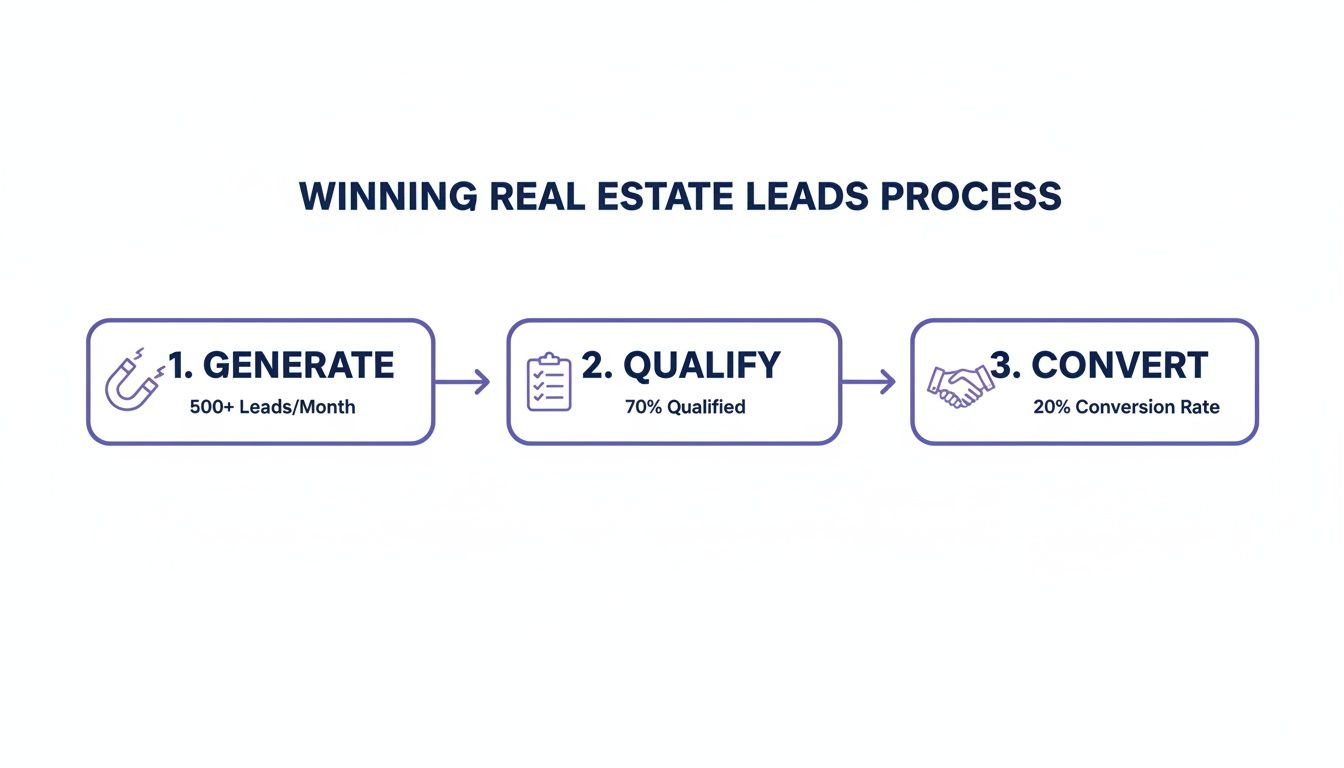
Your success depends on mastering each stage. Create a seamless journey for your leads. Do not let anyone fall through the cracks.
Core Components of a Winning System
Your lead generation machine has essential pillars. Each must work with the others. A weak part compromises the whole structure. If you are new to this, a foundational guide to lead generation marketing will get you started.
- High-Impact Channels: Do not cast a wide net. Focus on digital platforms with measurable returns. Use hyper-targeted social media ads and local SEO.
- Frictionless Capture: Website traffic is useless if it does not convert. Use compelling lead magnets like local market reports. Simple landing pages turn visitors into contacts.
- Automated Follow-Up: This is crucial. Set up instant email and SMS sequences to engage new leads. Speed is everything.
- An Intelligent CRM: This is your central hub. A good CRM organizes every lead, tracks every conversation, and automates your sales pipeline.
Agents who thrive by 2026 will not be the hardest workers. They will be the ones with the smartest, most automated systems.
Getting this right means having the right tech. An email-driven CRM handles administrative work and automates pipeline updates. Your team stays focused on high-value tasks. You can learn more about choosing the right platform in this guide on the best CRM for small business. The blueprint is here. Execute it.
Mastering High-Impact Digital Channels
Your digital presence is your 24/7 storefront. The days of casting a wide net are over. Success in real estate lead generation comes from precision. Focus on three core channels: paid advertising, local search, and social proof.
Your goal is not to be busy online. It is to build an inbound funnel that works while you sleep.
This is not about vanity metrics. We are creating a predictable system that delivers qualified prospects to your CRM. Every action must have a clear purpose and a measurable outcome.
Executing Targeted Ad Campaigns
Boosting posts is not a strategy. It is a gamble. Real results come from targeted campaigns on Meta and Google. These campaigns capture active buyers and sellers. Move beyond generic ads. Speak directly to what motivates people in your area.
A sharp Google Ads campaign targets high-intent keywords. Think "best real estate agent in Paddington" or "how much is my house worth in Mosman". Anyone typing that is ready to act. Your ad must link to a landing page that offers instant value, like a free home valuation tool.
Meta ads are different. You target life events and behaviors. A recently engaged person is a future buyer. A user who engages with luxury home content is a potential seller. Your ads must offer helpful suburb guides or market reports, not just property lists.
Your ad budget is an investment in data. Every click tells you more about your market. Use that intelligence to refine targeting and eliminate waste. Your goal is a lower cost per lead, every month.
The market is heating up. Australia's real estate sector faces a property surge. This is due to dropping interest rates and rebounding buyer confidence. New listings are critically low. This creates a supply-demand imbalance. CoreLogic data shows new listings are down 12% in Sydney and 15% in Adelaide. This scarcity sparks bidding wars, making targeted ads essential. You can learn how to prepare for the mid-2025 property surge.
Achieving Local SEO Dominance
Paid ads get results today. SEO builds a long-term asset. It generates free, high-intent leads for years. The objective is simple: own the search results for your area. When someone searches for a local agent, your name must be at the top.
You get there with a focused content strategy. Your website needs to be a resource. Create pages and posts that answer the questions local buyers and sellers are asking.
- Suburb Profile Pages: Create detailed guides for each suburb you service. Go deep on schools, amenities, market stats, and lifestyle. This positions you as the local expert.
- Targeted Blog Content: Write articles that solve real problems. Think "Downsizing in the Northern Beaches" or "A First-Home Buyer's Guide to Inner West Sydney."
- Google Business Profile: Your Google Business Profile is a non-negotiable tool. It must be optimized with professional photos, consistent information, and a steady stream of positive client reviews.
This effort compounds. An ad vanishes when you stop paying. A well-ranked article generates leads for years. By 2026, agents without this digital foundation will be at a massive disadvantage.
Building Authority Through Social Proof
Your social media channels are not for listing dumps. They are your stage for demonstrating authority and building social proof. Clients want evidence you deliver results. They want to see success stories, market insights, and proof of expertise.
Shift your content mix away from promotion. Your feed should reflect your professional competence.
What Effective Social Content Looks Like:
- Client Testimonials: Video testimonials are the gold standard. A short, genuine clip from a happy client is more persuasive than any ad.
- Case Studies: Detail a recent sale. Do not just post the 'Sold' picture. Discuss the challenge, the strategy, and the outcome. Show your work.
- Market Analysis: Post short videos breaking down local market trends. Explain what the data means in simple terms. This proves you are on the pulse.
Consistency is everything. You build your reputation one post at a time. Every piece of content should reinforce one message: you are the authority in your market. This builds trust, and trust converts leads into clients.
Engineering a High-Conversion Capture System
Getting traffic is half the battle. Without a system to capture it, you are wasting money. All your efforts are wasted unless you turn visitors into contactable leads. This process must be fast, smooth, and automated.
A timer starts the moment a client gives you their details. A clunky system creates costly delays. A well-oiled machine feeds your pipeline automatically.
Designing Irresistible Lead Magnets
A lead magnet is a fair trade. You provide valuable information. A prospect gives you their contact details. This is not a sales pitch. It is about solving an immediate problem for your ideal client.
The best lead magnets are specific and instantly useful. A generic "sign up for our newsletter" is not enough. You need resources that give local buyers and sellers tangible insights.
- Suburb Reports: Create a detailed PDF analysis of a local suburb. Include recent sales data, school rankings, and price trends. This is gold for buyers.
- Instant Appraisal Tools: Embed an automated valuation tool on your website. It gives homeowners an estimated value in seconds, capturing high-intent sellers.
- First-Home Buyer Checklists: A practical, step-by-step guide is a lifesaver for new buyers. Walk them through finance, settlement, and everything in between.
Tailor each magnet to a specific audience. A guide for downsizers will not work for an investor. This precision attracts higher-quality leads and makes your follow-up more effective.
Building Frictionless Landing Pages
Every lead magnet needs its own dedicated landing page. Do not send ad traffic to your homepage. A landing page has one job: to get the visitor to make the information exchange.
Simplicity wins. A high-converting page removes all distractions. That means no navigation menu, no links to other posts, and no competing calls to action.
Your page needs three things. A punchy headline that communicates the benefit. A few bullet points explaining what they get. A simple form asking for the minimum, usually a name and email.
Here is a simple rule. If an element on your landing page does not help capture the lead, remove it. Every word and image must serve that single purpose.
This focused approach makes the decision easy for the visitor. They either want the resource or they do not. That clarity drives high conversion rates.
Integrating Your System with a CRM
This is where it all connects. Your capture system is broken until it is hooked to your CRM. Manual lead entry is a recipe for disaster. It is slow, error-prone, and creates delays that kill deals.
An email-driven CRM is your best ally. When a prospect fills out a form, their details flow straight into your CRM. This action must automatically start your follow-up sequence.
This integration ensures two things happen every time. First, every lead is logged instantly. Second, your automated email and SMS follow-ups fire immediately, engaging the lead at peak interest.
This connection between your website and CRM turns lead generation from manual tasks into an automated system. By 2026, agents without this will be left behind. Engineer your system for speed and precision.
Executing a Flawless Follow-Up Sequence
The leads are rolling in. This is where most agents fail. It is where you will win. Generating leads is only half the battle. Success is in the precision of your follow-up. A flawless, automated sequence is your most valuable asset.
The game is won or lost in the first five minutes. A waiting lead goes cold. Your first contact must be immediate, automated, and valuable. A planned sequence of communication will nurture that relationship until they are ready to act.
This is not about being pushy. It is about being present, professional, and helpful. We will automate the repetitive tasks. This reserves your direct efforts for qualified prospects showing clear intent.
The Critical First Contact
A stopwatch starts when a lead hits your CRM. You have minutes, not hours. An automated welcome email and SMS must go out instantly. This confirms their request and sets a professional expectation.
The email delivers the lead magnet they requested. The SMS is a simple, personal introduction. This dual-channel approach increases your chance of immediate engagement. The goal is simple: establish a connection before they look elsewhere.
This speed is non-negotiable. Australian real estate data is clear. Agents who respond to appraisal requests within 24 hours convert 80% of them. Wait a day, and that number drops to 20%. Top performers make contact within 98 minutes and connect with over 75% of their inbound leads.
Designing the Nurture Cadence
After the first contact, the nurture sequence begins. This is a pre-planned series of communications that builds trust and showcases your expertise. The key is not to overwhelm them. The cadence is strategic, providing value at each step.
A good sequence mixes content types and communication channels. It is not an endless stream of listings. It is an educational conversation.
A Buyer Nurture Sequence Example (First 14 Days):
- Day 1: Instant delivery of the Suburb Report via email, with an introductory SMS.
- Day 3: An email with a short video explaining current market conditions for buyers.
- Day 5: A plain-text email asking if they have questions about the buying process.
- Day 8: An email with a relevant client success story or testimonial.
- Day 12: An invitation for a 15-minute chat to discuss their property goals for 2026.
This approach keeps you top-of-mind without being a nuisance. It positions you as the expert they should call when they are ready. The system does the heavy lifting. You can automate this process with smart follow-ups.
Segmenting for Maximum Relevance
A one-size-fits-all approach fails. Buyers, sellers, and investors have different needs. Your follow-up sequences must reflect this reality.
Your system should tag leads based on the magnet they downloaded. A home valuation request gets the seller sequence. A first-home buyer checklist gets the buyer sequence. It is that simple.
Your communication is only effective if it is relevant. Generic messages get ignored. Personalized, segmented follow-ups get replies.
This targeted approach feels like helpful assistance, not marketing. A seller receives market updates. An investor gets data on rental yields. This level of personalization separates amateurs from top producers.
Automating Your Pipeline with an Email-Driven CRM
Your CRM is not a filing cabinet. It should be an action engine. Traditional CRMs fail because they create more admin. That model is broken.
A smart, email-driven CRM works in the background. It watches your conversations and automatically updates your pipeline. This is the difference between a tool that makes work and a system that gets results.
Moving Beyond Manual Data Entry
Manual data entry is a tax on your productivity. Every minute you spend logging a call is a minute you are not closing a sale. For a small team, this inefficiency is a liability.
The solution is a system that works where you work: your inbox. When a lead replies, the system knows. When a conversation goes quiet, it gets flagged. This is the intelligence that defines modern real estate lead generation.
A CRM should tell you what to do next, not ask for an update. It serves you, not the other way around.
This approach centralizes all communication and client intelligence. It eliminates guesswork. Your entire action plan is on your phone, wherever you are. No more lost notes or forgotten follow-ups.
The Power of an Automated Action List
Clarity is everything. Knowing who to contact next is your most valuable asset. An email-based CRM uses AI to analyze your pipeline. It creates a simple, prioritized action list for you every day.
This is not a list of vague reminders. It is a precise set of instructions. It tells you who is going cold, who has re-engaged, and which deals need a nudge. It replaces chaos with a clear plan of attack.
This gives you an undeniable edge. While competitors drown in spreadsheets, you execute with precision. Your focus shifts from admin to the high-value conversations that grow your bottom line. Exploring the best CRM for real estate agents can show you the tools that make this possible.
Setting Up Your Automated Pipeline
Setting up this system is straightforward. Connect your email account. The platform starts monitoring your communications to build your pipeline. It automatically identifies deals and sorts contacts into the right stages.
Then you set the rules. A lead moves from 'Contacted' to 'Engaged' after a two-way email exchange. A deal in 'Proposal Sent' with no reply for seven days is automatically flagged for follow-up.
Here are a few essential automation rules:
- Stalled Conversation Alerts: Your safety net. Automatically flag any active deal without a reply in a set number of days.
- Stage Progression Triggers: Define email activities that push a deal to the next stage. An email with the word "agreement" could move a deal to 'Negotiation'.
- Automated Task Generation: Create tasks based on email content. A prospect asks for a valuation, and the system creates a task for you to schedule it.
These rules create a self-managing pipeline. The system handles logistics. You focus on strategy and client relationships. An email-based CRM is designed to make this process seamless.
By 2026, agents managing their pipeline by hand will be at a serious disadvantage. The market rewards speed and precision. An automated, email-driven CRM is the new standard.
Wrapping It Up: Your Blueprint for Success
The secret to real estate lead generation is not a complex formula. It is discipline and consistent execution. You now have the complete system.
The goal is a predictable client pipeline. You achieve this by mastering digital channels, building converting websites, and automating follow-up with a smart CRM. That is the core of a modern real estate business.

It All Comes Down to Execution
The real estate market is always changing. A solid system adapts. Looking ahead to 2026, successful agents will blend smart technology with relentless execution. This is non-negotiable.
Focus on the numbers that drive your business. These are the three you need to live by:
- Lead Volume: How many new prospects are you adding to your pipeline?
- Cost Per Lead: What is your total marketing spend divided by new leads?
- Conversion Rate: What percentage of leads turn into closed deals?
Track these figures weekly. When something works, invest more in it. If a strategy is not performing, cut it without hesitation.
A perfect plan is worthless without action. The system is in front of you. Your results will directly reflect your ability to execute it.
This is not theory. It is a practical framework for building a dominant real estate business. The plan is laid out. Now, execute.
Burning Questions, Answered
You have questions. I have answers. Let's get to it.
What’s the smartest lead generation play for a small team?
A small team cannot be everywhere at once. Be strategic. The most powerful combination is hyper-local SEO paired with targeted social media ads.
It is a one-two punch. Your SEO builds a valuable, long-term asset. You rank for "best agent in [your suburb]," which brings free, high-intent traffic. At the same time, Meta ads give you immediate, predictable results. You can target people by postcode, income, and life events that signal a move.
This approach gives you both quick wins and a sustainable pipeline.
How does an email-based CRM actually help convert more leads?
Agents lose deals because of inconsistent follow-up. An email-based CRM solves this by automating the admin that lets opportunities die.
It tracks every conversation for you. It knows when a conversation has gone cold and flags it automatically. You get a simple, prioritized to-do list each morning. This relentless, automated persistence keeps more conversations moving forward.
A CRM should make you money, not work. Its job is to handle low-value tasks so you can focus on high-value conversations that close deals.
What’s the right length for an automated nurture sequence?
For real estate, your nurture sequence needs to run for six to twelve months. Anything shorter is leaving money on the table. People have long timelines. Your goal is to be the agent they think of first when they are ready.
Timing matters. Be more frequent in the first few weeks. Then ease off to a weekly or fortnightly check-in. The critical part is this: the sequence must stop the second they reply. By 2026, this smart automation will be the standard for any serious agent.
Your pipeline is the lifeblood of your business. Ralivi is an email-based CRM designed to keep it full by getting rid of manual data entry and telling you exactly who to follow up with next. Get your priorities straight and start closing more deals. Find out more at https://www.ralivi.com.